
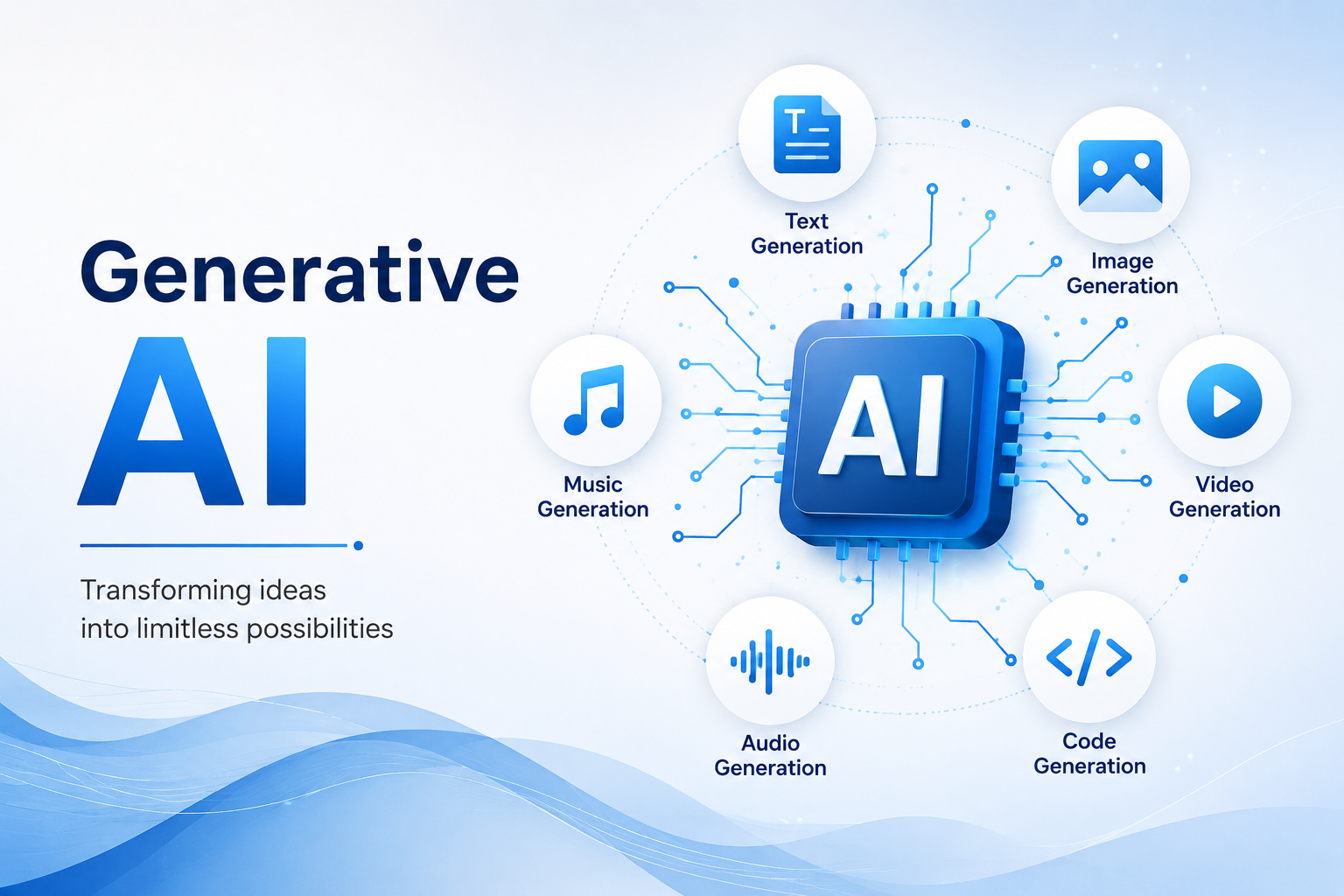
The catalyst every boardroom is whispering about is none other than Generative AI. More than just a technological leap, Gen AI is reshaping how businesses think, operate, and compete. Unlike traditional AI, which analyses and predicts, Gen AI models create new content, strategies, workflows, and even entirely new ways of working.
For enterprises struggling with manual processes, siloed data, and slow decision-making, this isn’t just innovation – it’s survival. From intelligent automation to hyper-personalised customer experiences, the AI Gen revolution is redefining efficiency and scale. Companies are now turning to Gen AI consulting and trusted Generative AI development companies to uncover transformative Gen AI use cases that deliver measurable results. As per Statista, the market is projected to grow at a CAGR of 36.99% between 2025 and 2031, reaching a total value of US$442.07 billion by 2031.
In this article, we’ll pull back the curtain on Generative AI, exploring its real-world use cases, business benefits, and why it’s fast becoming the cornerstone of modern enterprise strategy.
Table of Contents
Things you cannot miss
When data speaks
Expected AI-driven sales by 2032.
Projected compound annual growth rate (CAGR) for AI through 2032.
Projected size of the AI training market by 2032.
AI in Small Businesses
Small companies are using agility to outpace standard integration pipelines:
Source: Digital Silk
What is Generative AI?
Generative AI is a branch of artificial intelligence that focuses on creating new and original content rather than just analysing existing data. It uses advanced models like neural networks and transformers to learn from huge datasets and then generate human-like outputs such as text, images, audio, video, or even computer code.
Text Generation
Tools like ChatGPT write dynamic web copies, long-form blogs, or hyper-specific product guides instantly.
Image Creation
DALL·E and MidJourney generate production-grade digital artworks and modern product designs from simple prompts.
Music & Audio
AI engines like AIVA build custom atmospheric soundscapes, commercial jingles, or sound effects on demand.
Code Writing
Platforms like GitHub Copilot accelerate dev lifecycles by writing boilerplate architectures and debugging routines.
How does Gen AI work?
Generative AI works by identifying underlying patterns, structural rules, and deep contextual parameters hidden inside vast source datasets.
The Training Process
Before model architectures can create new data, they undergo intensive training stages. Instead of matching explicit labels manually, they are typically constrained or restricted—forcing them to decipher abstract features on their own, such as basic physics inside images or core syntax structure in languages.
"By failing and adjusting millions of times, the AI creates maps of human style. It learns what makes an asset realistic without copying it pixel-for-pixel."
Most state-of-the-art pipelines use semi-supervised training. By feeding models massive blocks of unlabelled raw data alongside curated high-quality datasets, they synthesize a multi-dimensional understand of the world far beyond explicit human instructions.
Models Used in Generative AI
Generative Adversarial Networks
A constant zero-sum battle between two networks to drive synthetic precision:
Transformer-Based Models
The mathematical engine behind Large Language Models. They rely on **self-attention modules** to track connections between remote elements in sequence.
- Parallel Execution: Processes sequence arrays simultaneously rather than piece-by-piece.
- Long-Range Context: Retains core conversational context over thousands of lines.
Variational Autoencoders
A system built to compress, extract features, and reconstruct data with randomized styles:
Diffusion Models
Destructs structural data into static noise and learns to perfectly reconstruct the asset step-by-step.
Flow-Based Models
Uses highly invertible mathematical transformations to compute exact probability distributions.
Allows the model to transition smoothly from simple normal distributions directly into high-fidelity image structures without relying on heavy approximations.
Generative AI Use Cases
Transforming global industries with intelligent automation
Healthcare
Generates synthetic visual scans for clinical training data, engineers innovative molecular compounds to reduce drug discovery timelines, and structures unstructured patient charting records.
Marketing & Advertising
Tailors infinite, hyper-personalized messaging and assets based on customer profiles.
Entertainment & Media
Constructs complex backing music compositions, prototypes 3D asset sketches, produces advanced cinematic VFX elements, and crafts outline narratives.
Finance & Banking
Synthesizes safe, non-private transactional mock data to benchmark fraud-detection systems and runs deep-market simulations to mitigate risk.
Retail & E-commerce
Drafts rich product detail copy instantly, designs custom mock catalogs, and creates context-sensitive shopping recommendations dynamically.
Education & Training
Creates complete educational outlines, writes automated customized evaluation tests, and generates conversational explanation agents for tutoring.
Automotive & Manufacturing
Optimizes structural chassis and wing layouts using generative physics models to save weight while matching strict structural safety ratings.
Real Estate
Constructs 3D spatial walks and visualizes architectural expansions instantly based on rough sketches and blueprint notes.
Fashion & Apparel
Simulates fabrics and pattern models across multiple digital environments, drastically reducing actual sample manufacturing waste.
Gaming
Constructs procedural environments on-the-fly, designs voiceover dialogues, and models rich non-player character (NPC) behavior nodes.
Media & Journalism
Synthesizes long source records into quick news bulletins, formats transcripts automatically, and accelerates publication speed for breaking events.
How is Generative AI beneficial to business?
Driving enterprise efficiency and value models
Businesses are increasingly turning to a generative AI development company and leveraging Gen AI models to streamline operations, drive innovation, and enhance decision-making. With real-world Gen AI use cases and proven AI Gen solutions, companies can automate workflows, personalise experiences, and unlock new growth opportunities.
Streamlined Business Operations
Gen AI automates repetitive workflows, reduces manual errors, and speeds up processes, making day-to-day operations more efficient.
Rapid Content & Product Creation
From marketing copy to design prototypes, Gen AI enables businesses to produce high-quality content and products faster than traditional methods.
Data-Driven Insights
By generating simulations and analysing complex datasets, Gen AI helps companies make smarter, faster, and more informed decisions.
Enhanced Customer Engagement
AI-generated personalised communications, recommendations, and interactions improve customer experience and brand loyalty.
Cost Optimisation
Automating processes and generating assets in-house reduces dependence on external resources, lowering operational costs.
Scalable Innovation
Businesses can experiment with new ideas, strategies, and designs at scale without heavy investments or delays.
Agile Decision Support
Gen AI can predict trends, simulate market scenarios, and model outcomes, helping leadership adapt strategies proactively.
Competitive Differentiation
Companies leveraging Gen AI gain a clear advantage by innovating faster, delivering superior experiences, and optimising resources.
Emerging Agents in Generative AI
Agents are becoming one of the most exciting developments in generative AI, representing systems that can autonomously perform tasks, make decisions, and interact with their environment. Unlike traditional AI models that generate content only when prompted, agents can plan, execute, and adjust their actions based on real-time feedback, making them more dynamic and adaptable.
These AI agents can integrate multiple generative AI capabilities, such as text, vision, and reasoning, to handle complex workflows without constant human intervention. For instance, an agent could draft emails, schedule meetings, and summarise reports while continuously learning from user behaviour to improve efficiency.
The emergence of agents marks a shift from reactive AI to proactive AI, where systems not only respond to instructions but also anticipate needs, optimise processes, and solve multi-step problems. This trend is opening new possibilities in automation, personalisation, and decision support across a variety of domains.
As generative AI continues to evolve, agents are expected to become increasingly sophisticated, capable of collaborating with humans and other AI systems, and driving innovation in ways that were previously unattainable.
The Future of Generative AI
Generative AI is poised to redefine creativity, productivity, and decision-making across all sectors. In the near future, AI will not just assist humans – it will collaborate with them, generating ideas, solving problems, and automating complex workflows in real time. Multimodal AI, capable of seamlessly understanding and producing text, images, audio, and video, will make interactions more natural and intelligent than ever.
The rise of autonomous AI agents will further accelerate this shift, allowing AI systems to operate independently, integrate multiple tools, and make informed decisions with minimal human guidance. Personalisation will reach new heights, as AI anticipates individual needs and tailors solutions with remarkable precision. Forward-thinking enterprises are already partnering with a generative AI development company to build intelligent solutions that drive efficiency and unlock new growth opportunities.
We will also see generative AI becoming a cornerstone for innovation—simulating scenarios, designing new products, and uncovering insights that were previously impossible to achieve. At the same time, ethical frameworks and regulations will evolve to ensure responsible and safe use, balancing innovation with accountability.
Ultimately, the future of generative AI points to a world where humans and intelligent machines co-create, innovate, and solve challenges together, unlocking once unimaginable opportunities.
End Note
The future belongs to those who harness the power of AI, and a generative AI development company can make that future a reality. By building advanced Gen AI models and with expert Gen AI consulting, businesses can unlock creativity, efficiency, and innovation like never before. Real-world Gen AI examples and practical Gen AI use cases show how AI is transforming industries, generating content, and delivering personalised experiences. With smart AI Gen solutions, organisations can stay ahead of the curve and fully leverage the limitless potential of generative AI.
Ready to transform your business with the power of AI? Partner with us today and transform your business with intelligent, scalable solutions. Don’t wait to see how AI Gen can reshape your operations – contact us today and let’s co-create the next big breakthrough for your business.